
Board Types & Classifications
Single-phase consumer units, three-phase TPN boards and busbar architecture explained
Board Types & Classifications
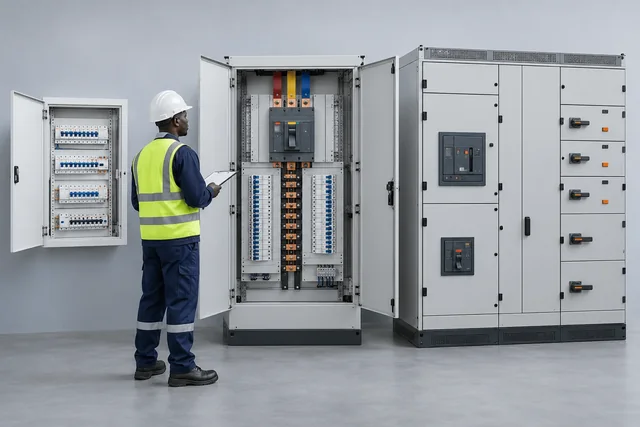
Classify a board by its phase arrangement, incoming and outgoing circuits, enclosure, internal separation and verified electrical performance. The reference images below distinguish a single-phase consumer unit, a wall-mounted distribution panelboard and a cubicle switchboard lineup.
SPN and TPN describe the supply arrangement. Horizontal or vertical chassis describes the physical device layout. Type A and Type B board terminology must be interpreted using the manufacturer’s range documentation; it is not a universal current rating or the same as an MCB trip curve or RCD type.
Board Architecture In Practice
Single-Phase Metal Consumer Units
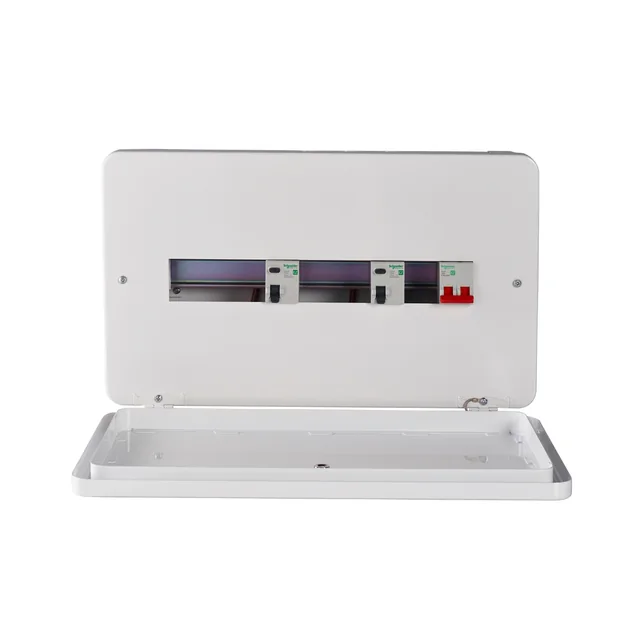
The Schneider Electric Easy9 EZ9EFS12CMCU is a 12-way single-phase metal consumer-unit reference for final circuits. MCB, RCD and RCBO selection, loading and enclosure configuration must be confirmed for the actual board.
Three-Phase TPN Distribution Panelboards
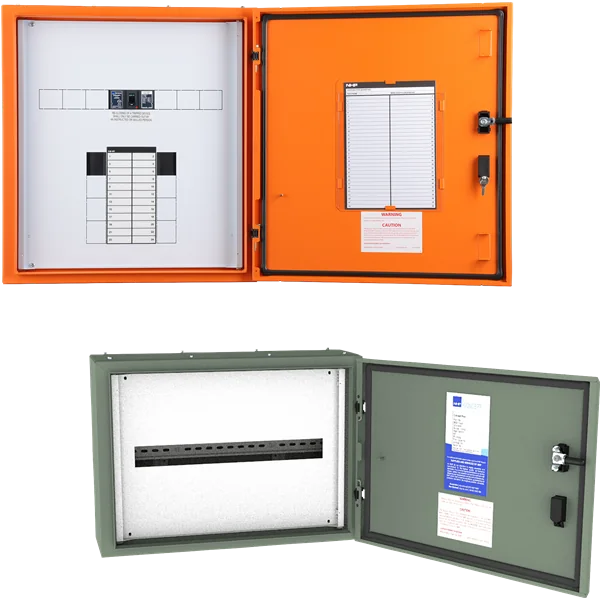
The NHP Concept Plus family shows a wall-mounted panelboard with its accessory enclosure, suitable as a sub-distribution reference. This Australian AS/NZS 61439-3 range has isolator incomers up to 250 A or MCCB incomers up to 200 A; it is not a Form 4 main-switchboard lineup.
Cubicle Switchboard Lineups & Separation
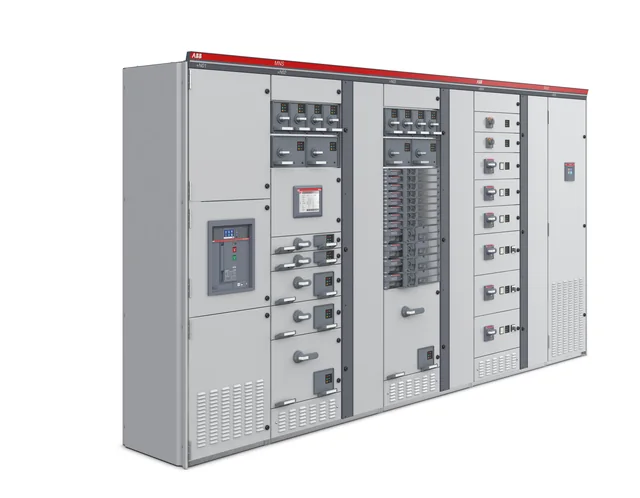
ABB MNS Digital is pictured as a primary-intake and motor-control lineup reference. NPE project assemblies are specified from the load schedule, prospective fault current and operating conditions; the photograph does not establish a particular current, fault or separation rating.
Explore Cubicle Switchboard Lineups & SeparationSingle-Phase vs Three-Phase Boards
| Selection item | Single-phase final board | Three-phase distribution board |
|---|---|---|
| Supply | 230 / 240 V AC, phase + neutral | 400 / 415 V AC, three phases + neutral, 50 Hz |
| Pictured reference | Schneider Electric Easy9 12-way consumer unit | NHP Concept Plus Australian panelboard family |
| Incomer | Select the exact consumer-unit configuration | Pictured NHP family: isolator up to 250 A or MCCB up to 200 A |
| Outgoing protection | MCB / RCBO circuits as specified | Single- or multipole devices supported by the chosen chassis |
| Fault rating | Match the actual assembly and device ratings to the fault study | Confirm assembly withstand and device Icu / Ics at system voltage |
| Standard scope | IEC 61439-3 where applicable to the actual assembly | IEC 61439-2 or -3 according to assembly scope; pictured family AS/NZS 61439-3 |
Type A vs Type B Busbar Orientation
| Layout term | Meaning | Selection limit |
|---|---|---|
| SPN / TPN | Phase and neutral arrangement | Confirm actual circuit and supply requirements. |
| Horizontal / vertical chassis | Physical layout of busbars and outgoing devices | Verify compatible device families; orientation alone does not establish current or fault rating. |
| Type A / Type B board | Range-specific distribution-board terminology | Use the board manufacturer’s definition; do not confuse it with MCB trip curves or RCD types. |
Forms of Separation (IEC 61439-2)
| Form · IEC 61439-2 | Separation principle | Engineering note |
|---|---|---|
| Form 1 | No internal separation | Select against project access and operation needs. |
| Form 2 | Busbars separated from functional units | The a/b subdivision defines terminal separation from busbars. |
| Form 3 | Busbars separated from units; units separated from one another | Specify the terminal arrangement and required a/b subdivision. |
| Form 4 | Additional separation of terminals associated with each functional unit | Specify the exact arrangement. Separation does not permit live maintenance. |
Key Features Across All Board Types
- Type-tested / design-verified assemblies to IEC 61439 with verification documents confirmed for the proposed assembly
- Frames from 2.0–2.5 mm sheet steel; doors and covers from 1.2–1.6 mm sheet steel
- HDHC tin-plated copper busbars with no-drill clamp connections
- Standard IP43 ingress protection; IP54 and IP65 available on request
- Epoxy powder-coated light grey RAL 7035 at 50–75 micron thickness
- Tested for operation at 50 °C ambient temperature
- Front or rear cabling access with removable gland plates and barriers
- Modular frame widths of 400, 600, 800 and 1000 mm; depths of 800 or 1000 mm
Typical Applications
Need Help Selecting the Right Board Type?
Send your single-line diagram and load schedule and we will recommend the correct board configuration for your project.
Explore your requirements.
Try the tools relevant to board types & classifications, compare scenarios, then send the inputs to our team.
Enable JavaScript for live calculations, or ask our engineering team.
Connect your application to the right components.
Explore these related component families, compare exact manufacturer references and build a quotation request.
LOVATO manufacturer family images; exact configurations vary by model.
Send a BOQ or parts list