

KPLC Power Factor Penalty in Kenya
To assess a Kenya Power power-factor charge, identify the tariff category and operative tariff clause on the account, then compare them with the billed measurements. Capacitor correction can reduce fundamental reactive demand, but this page does not assert an unverified current threshold, surcharge rate or saving for a customer account.
Engineer author: awaiting NPE confirmation. Published: . Updated: .
Items awaiting confirmation: Confirm the operative tariff category, power-factor adjustment clause, effective date, Gazette reference, threshold and rate before publishing an account-specific charge example.
Electrical quantities are not a tariff rule
Swipe across the diagram, or focus it and use the arrow keys. The key points are written below.
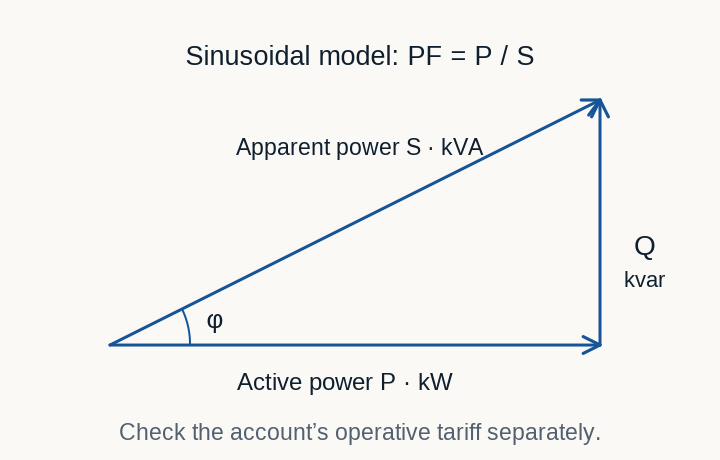
- At the same kW, a lower power factor means a larger kVA.
- Confirm the tariff category, effective date and operative clause.
- Use matching-period account measurements before assessing a charge.
Separate billing rules from electrical quantities
Active power is measured in kW and apparent power in kVA. Under the usual sinusoidal model, power factor is their ratio. At the same active power and voltage, lower power factor requires more current. That electrical relationship does not by itself identify which charge appears on a particular bill or how the tariff calculates it.
For illustration, 100 kW at a power factor of 0.80 corresponds to 125 kVA in that model. This is arithmetic, not a customer meter reading or a tariff example. The account’s category, assessment period, billing units and current approved schedule must be established before translating an electrical change into a monetary claim.
Check the operative document and the bill together
EPRA publishes tariff information and regulates electricity tariff structures. Kenya Power provides customer tariff information. A historic schedule or a widely repeated market figure is not sufficient evidence that an exact threshold and rate apply to an account today. Record the document date and clause used in any account-specific assessment.
Ask for the bill pages showing the account category, demand quantities and any power-factor or reactive-charge line. Check that the quantities relate to the same billing period. If the wording or measurement basis is unclear, obtain clarification from the utility or an appropriately qualified tariff adviser before calculating a claimed avoidable charge.
Assess correction without promising a result
Where fundamental reactive demand is relevant, measured kW and displacement power factor can be used to estimate required capacitive correction. Load variation matters: a bank sized at one operating point may not control another. Harmonics, voltage and source configuration must be reviewed before deciding whether a plain bank, detuned arrangement or different mitigation is appropriate.
Existing correction should also be investigated before replacement. Record which stages are available, the controller measurement location and the operating conditions of any apparent shortfall. Following work, compare equivalent measurement periods and retain the evidence. A changed bill can reflect production or tariff changes as well as correction; do not attribute every difference to the panel.
| Account check | Evidence required |
|---|---|
| Applicable category | Current account and tariff documentation |
| Power-factor adjustment | Operative clause and effective date |
| Billed quantity | Matching-period meter or bill data |
| Correction outcome | Comparable operating measurements before and after |
Frequently asked questions
What power factor avoids the KPLC penalty?
The applicable answer must come from the operative approved tariff and the account category. This page intentionally does not substitute an unverified threshold or rate. Obtain the current clause and its effective date, then have the account-specific interpretation checked. A controller setpoint and a utility billing requirement are related decisions but are not the same thing.
Will an APFC panel guarantee a lower bill?
No billing outcome can be guaranteed from a panel description alone. Establish whether the relevant charge applies, measure the reactive demand and verify the correction design. Production, operating hours and tariff changes can also affect a bill. A savings assessment needs an explicit baseline and comparable conditions after the work, not just a before-and-after total.
Can capacitors reduce every form of poor power factor?
Capacitors supply fundamental reactive power and can improve displacement power factor where that is the problem. Distorted current can also reduce true power factor, and a plain bank can interact adversely with network harmonics. Identify the measured quantity and harmonic conditions before selecting equipment; correction and harmonic filtering should not be treated as interchangeable remedies.
Plan the next step
Explore the relevant product range · Use the planning calculator · Contact NPE