

IE3 Motors in Kenya: Selection and Energy Payback
IE3 identifies a motor efficiency class within the IEC framework for line-operated AC motors. It is not a single efficiency percentage or a guarantee of system savings. Compare the candidate motors at the required shaft duty, annual operating hours and verified energy cost, while checking that their mechanical and electrical characteristics suit the machine.
Engineer author: awaiting NPE confirmation. Published: . Updated: .
Where motor input energy goes
Swipe across the diagram, or focus it and use the arrow keys. The key points are written below.
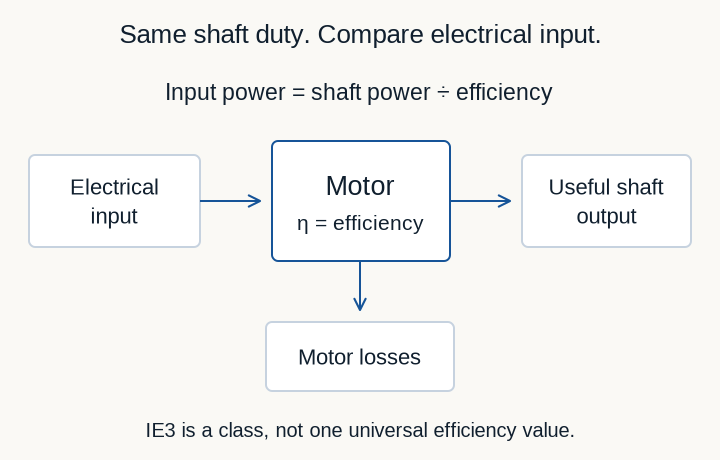
- Compare motors at the same required shaft duty.
- Use manufacturer efficiency data at the relevant load.
- Apply verified operating hours and energy cost to the saving calculation.
Read the efficiency class alongside the duty
The applicable efficiency-class requirements depend on the motor’s characteristics and the scope of the relevant standard. IEC 60034-30-1 concerns line-operated AC motors. Identify the edition referenced in the specification and obtain the actual manufacturer efficiency data, rather than assigning an efficiency percentage from the IE3 label alone.
Consider loading over the working cycle. Nameplate output is not necessarily the shaft power used continuously. Efficiency varies with load, and operating hours can include idle or lightly loaded periods. Establish a defensible duty profile before comparing annual energy. Where measurements are incomplete, record the uncertainty and test more than one scenario.
Calculate savings without inventing a tariff
For equal shaft output, electrical input power is shaft power divided by efficiency expressed as a fraction. The annual energy difference is shaft kW multiplied by running hours and by the difference between the reciprocals of the two efficiencies. Separate operating periods can be calculated and added when the duty changes.
Use the customer’s applicable energy-cost input to convert the energy difference into a cost scenario. Simple payback divides the relevant installed cost difference by positive annual cost savings. State whether the comparison is a planned replacement, a failed-motor replacement or an early replacement, because the relevant cost basis differs.
Check the complete motor-driven system
Matching output power alone does not establish interchangeability. Verify voltage, frequency, speed, mounting, shaft dimensions, enclosure protection, cooling method and duty. Review starting characteristics and protection settings against the specific motor. The efficiency class does not remove the need to assess acceleration, supply disturbance or mechanical compatibility.
If the motor will run from a VFD, check the permitted speed range, cooling at reduced speed, insulation requirements and cable arrangement. Operating conditions for an inverter-fed motor require their own evaluation; a line-operated efficiency class is not a complete inverter-duty specification.
Inspect the driven process before treating a motor replacement as the only improvement. Unnecessary running, poor mechanical alignment, inappropriate control and an unsuitable duty point can affect system consumption. Record both the motor comparison and any process change separately, so that projected savings are not counted twice or attributed to the wrong intervention.
| Selection input | Evidence to obtain |
|---|---|
| Efficiency | Manufacturer data at the relevant duty and declared class |
| Energy use | Shaft duty profile and annual operating hours |
| Cost scenario | Customer-confirmed energy cost and installed cost difference |
| Compatibility | Mechanical dimensions, starting, cooling and supply conditions |
Frequently asked questions
What percentage efficiency does IE3 mean?
IE3 does not identify one percentage for every motor. The class must be interpreted within the applicable standard and motor characteristics, and the manufacturer provides the declared efficiency for the specific design. Compare the actual candidates at the intended operating point rather than inserting a universal IE3 number into a payback calculation.
Does an IE3 motor always pay back quickly?
No fixed payback period can be stated without the actual comparison. Running hours, shaft load, candidate efficiencies, energy cost and installed cost difference determine the result. A short-duty motor can have a very different economic case from a continuously used motor, even when their rated outputs and efficiency labels match.
Can I replace a motor with another of the same kW?
Check more than kW before treating the motors as interchangeable. Confirm speed, frame, mounting, shaft, voltage, frequency, cooling and operating duty. Also review starting current, starting torque and protection. For a drive-fed application, assess the manufacturer’s inverter-use requirements and the machine’s operating-speed range separately.
Plan the next step
Explore the relevant product range · Use the planning calculator · Contact NPE