

DOL, Star-Delta, Soft Starter or VFD?
Choose the starting method from required accelerating torque, supply disturbance, starting frequency and speed-control needs. DOL applies the supply directly; star-delta temporarily reduces winding voltage; a soft starter controls applied voltage during starting; a VFD controls frequency and voltage. Check the actual motor and driven load rather than selecting solely by motor size.
Engineer author: awaiting NPE confirmation. Published: . Updated: .
Choose a starter from the operating task
Swipe across the diagram, or focus it and use the arrow keys. The key points are written below.
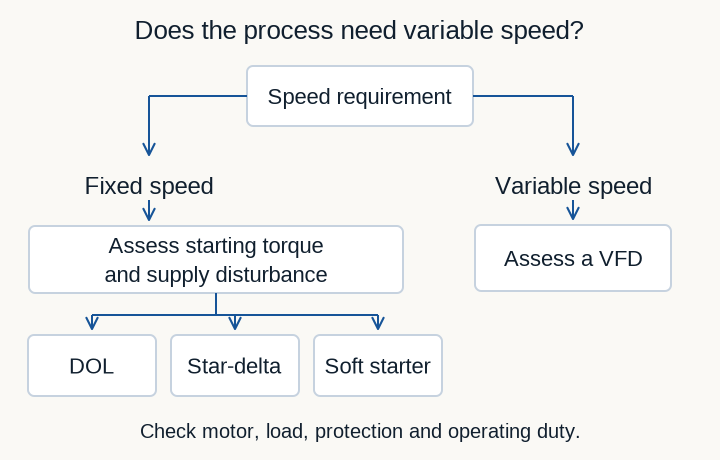
- Decide whether the process needs operating-speed control.
- Check accelerating torque and permitted supply disturbance.
- Confirm motor compatibility, duty and manufacturer protection data.
Compare starting current with accelerating torque
A motor accelerates only when its developed torque exceeds the driven load torque throughout the speed range. A lower starting current is therefore not sufficient evidence of a suitable starter. Obtain motor starting data and describe the machine’s torque, inertia and loaded or unloaded starting condition.
Direct-on-line starting applies the line supply without a voltage ramp. Assess the resulting current and torque against the network and machine. A voltage dip at the starter supply can affect other equipment, particularly when the source includes a generator or a long feeder. Use the actual starting data rather than a fixed universal current multiple.
Understand the reduced-voltage choices
Star-delta requires an accessible winding arrangement and a motor suitable for delta operation at the running line voltage. In the ideal comparison with direct delta starting, the star connection reduces line current and torque. The reduced torque may prevent acceleration, while changeover can introduce a transient; a timer alone cannot resolve an unsuitable motor-load combination.
A soft starter changes the voltage applied during starting and stopping. Its settings must balance current limitation with the torque needed to accelerate. Check starting duration, starts per hour, bypass arrangement and overload protection. It generally does not provide continuous operating-speed control after the starting sequence.
Use a drive for the required operating task
A VFD provides adjustable frequency and voltage, allowing speed to be matched to a process. Continuous low-speed torque, overload duration and motor cooling depend on the selected drive and motor arrangement. Do not assume that every combination provides rated torque at zero speed or that any existing motor is automatically suitable.
For a variable-demand pumping or ventilation system, compare speed control with the existing control method across actual operating points. Static head, machine efficiency and process limits affect the result. A constant-demand machine does not acquire an energy saving simply because a VFD is fitted.
Include cable length, insulation stress, earthing, electromagnetic compatibility, harmonics and enclosure cooling in the specification. Review isolation, emergency functions and restart behaviour independently of the normal start command. Confirm manufacturer protection and coordination information, then commission the settings against the real machine.
| Method | Operating mechanism | Selection check |
|---|---|---|
| DOL | Direct supply connection | Supply disturbance and machine torque |
| Star-delta | Temporary star connection before delta running | Winding compatibility, acceleration and transition |
| Soft starter | Controlled voltage during start/stop | Starting duty and acceptable fixed running speed |
| VFD | Controlled operating frequency and voltage | Speed range, motor compatibility and thermal duty |
Frequently asked questions
Does star-delta always start a motor successfully?
No. The winding arrangement must suit the supply, and the motor must develop enough torque in star to accelerate the driven load. Check the torque-speed characteristics, inertia and transition behaviour. A machine that remains below its required speed may experience excessive starting time even though the initial current is reduced.
Can a soft starter provide continuous speed control?
A conventional soft starter controls the applied voltage during starting and, where supported, stopping. It is not a substitute for a variable-frequency drive when the process requires adjustable running speed. Confirm the chosen device’s functions and starting-duty limits, including the operating bypass arrangement, before deciding that it meets the application.
How should starting current be entered in a planning calculator?
Use the motor or starter manufacturer’s data for the actual starting arrangement and loading condition. A planning multiplier is an explicit scenario assumption, not a measured current or guaranteed limit. Investigate source impedance, acceleration time and protection coordination separately before using an estimate to specify the installation.
Plan the next step
Explore the relevant product range · Use the planning calculator · Contact NPE