

Capacitor Bank Sizing in Kenya
Size a capacitor bank from measured active power and the change in displacement power factor: Qc = P × [tan(arccos PF1) − tan(arccos PF2)]. The result is fundamental-frequency correction in kvar at one operating point. Stage arrangement, harmonics, voltage and protection still require separate selection.
Engineer author: awaiting NPE confirmation. Published: . Updated: .
Correction reduces reactive demand at the same kW
Swipe across the diagram, or focus it and use the arrow keys. The key points are written below.
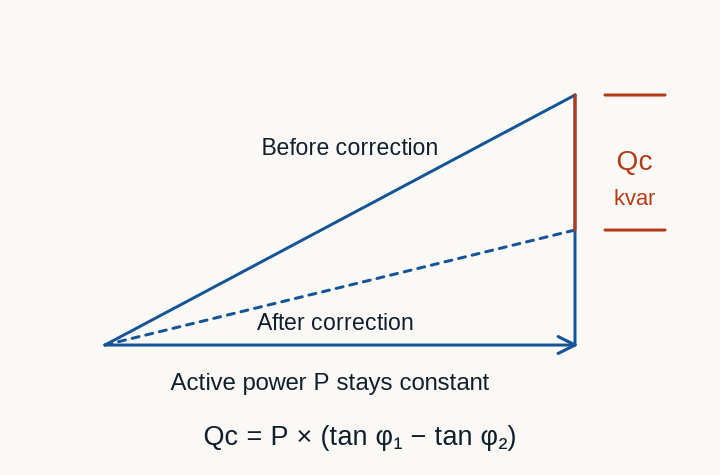
- Use simultaneous kW and displacement-power-factor readings.
- Qc is the change in fundamental reactive demand.
- Repeat the calculation for light and heavy operating states.
Use comparable measurements
P must be active power in kW, measured for the same operating condition as the initial power factor. Do not combine a peak kW reading with a power factor recorded during another shift. The target is a project decision that must reflect the supply arrangement and avoid leading operation when demand falls.
The equation assumes the relevant power factors describe fundamental displacement. It does not convert distorted current into a sinusoidal waveform. If a meter reports only total power factor, establish whether distortion materially contributes before applying the simple calculation. Keep the measurement definition with the result so another engineer can reproduce it.
Build a range rather than one number
Calculate correction for meaningful load states: normal operation, maximum production and minimum sustained demand. A fixed bank remains connected regardless of load unless separately controlled. Automatic stages provide discrete changes. Their useful resolution depends on the smallest stage, not merely on the number of controller outputs available.
An illustrative calculation is not a record of a customer installation. For example, at 100 kW, improving displacement power factor from 0.80 to unity gives 75 kvar from the equation. That arithmetic does not recommend a 75 kvar fixed installation: the actual low-load condition, harmonics and desired control margin remain unknown.
Check what the capacitor rating means
Reactive output depends on capacitance, frequency and voltage squared. A nameplate kvar value therefore belongs to its specified voltage and frequency. Read the manufacturer data before comparing alternatives; two labels cannot be compared solely by their printed kvar if their reference conditions differ. Reactor combinations need their own assembled output assessment.
The calculation does not establish capacitor voltage duty, switching-device suitability, fault protection, ventilation or completed-panel verification. Request these as separate schedule items. Where a manufacturer reference or a required value is absent from the catalogue, leave that field unresolved for engineering confirmation instead of substituting a familiar part number.
| Check | Selection consequence |
|---|---|
| Measured kW and displacement PF | Establish theoretical correction |
| Minimum and maximum demand | Choose fixed or staged operation |
| Reference voltage and frequency | Compare actual reactive output |
| Distortion and source impedance | Assess reactor and filtering requirements |
Frequently asked questions
Can a capacitor bank be oversized?
Yes. A bank selected only for a high-load condition can supply excessive capacitive reactive power after demand falls. This can cause leading operation and may affect voltage. Evaluate minimum sustained demand and the control sequence. Do not assume that the largest available bank is the safest or most effective choice.
Does the formula select capacitor part numbers?
No. It produces a reactive-power requirement under stated assumptions. Individual capacitor references, reactor compatibility, switching duty and protection must then be established from manufacturer data and the assembly design. A complete enquiry should identify those decisions separately so that the theoretical kvar result is not mistaken for an approved bill of materials.
Why does the operating voltage matter?
For a fixed capacitance at a fixed frequency, reactive output changes with the square of voltage. Nameplate output is consequently tied to its rating conditions. Use the actual system conditions and manufacturer information, especially for reactor-capacitor combinations. Voltage and harmonic duty also affect whether the proposed component is suitable, independently of the initial kvar calculation.
Plan the next step
Explore the relevant product range · Use the planning calculator · Contact NPE