

APFC Panels in Kenya
An automatic power factor correction panel switches capacitor stages to follow changing reactive demand. Specify its correction capacity, step sizes and harmonic suitability from measurements across the operating cycle. A panel cannot be selected responsibly from the incoming breaker rating or the total motor nameplate power alone.
Engineer author: awaiting NPE confirmation. Published: . Updated: .
What the APFC controller needs to see
Swipe across the diagram, or focus it and use the arrow keys. The key points are written below.
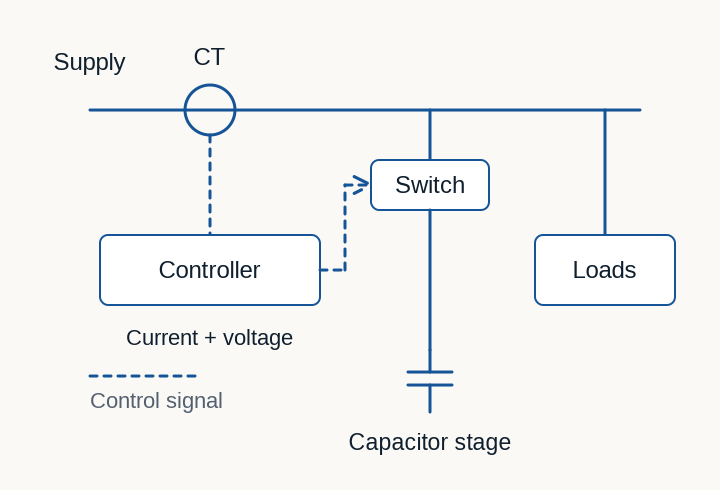
- Measure the combined load and capacitor balance.
- Select stage sizes from changing reactive demand.
- Confirm CT polarity, voltage reference and protection in the engineered design.
What the controller must see
The controller needs a correctly located current measurement and the appropriate voltage reference. If the current transformer excludes a feeder or the capacitor connection, the controller may respond to the wrong balance. Record the proposed measurement point on the single-line diagram and identify which circuits remain outside its view.
Load records should distinguish working hours, reduced production, overnight operation and generator supply. A single favourable reading does not describe these states. Simultaneous kW, kvar, voltage and displacement power factor allow the designer to identify the correction required at each state rather than quote one average value.
Translate demand into switched stages
Total kvar describes the upper correction requirement; stage size determines how closely the bank follows smaller changes. An excessively large first stage may overcompensate a lightly loaded installation. Switching delays and discharge arrangements must also suit the equipment. Faster switching is not automatically better when it increases unnecessary operations.
Capacitor duty requires an assessment of switching inrush, residual charge, protection and the coordination of each branch. The assembly also needs access for maintenance and a means of isolating it. Component selection and the verification of the completed assembly are separate tasks; a reputable component brand does not establish an assembly rating.
Resolve harmonics before committing to a bank
Nonlinear equipment changes the current waveform. A displacement power factor reading can therefore look satisfactory while true power factor remains lower because distortion is present. Capacitors address fundamental reactive demand; they are not a general treatment for waveform distortion. Describe which power factor the meter and controller display.
The enquiry should include the harmonic spectrum, transformer data, existing correction equipment and any planned load additions. The review may lead to a plain bank, a reactor-capacitor combination, filtering, or further measurements. None follows automatically from the presence of one drive. Record the decision and its assumptions before placing an order.
| Selection input | Why it changes the panel |
|---|---|
| Measured kvar over the load cycle | Sets correction range |
| Light-load condition | Sets minimum useful step |
| Harmonic spectrum and source impedance | Informs resonance review |
| Installation and access | Determines enclosure and maintenance requirements |
Frequently asked questions
How do I size an APFC panel?
Begin with simultaneous active and reactive demand measurements over representative production conditions. Calculate correction at each important operating state, then review the smallest step as well as total kvar. Include supply configuration and harmonic measurements. The resulting requirement is a design input, not a complete component schedule or a guaranteed billing outcome.
Does having VFDs mean I need reactors?
The presence of drives is a reason to investigate, not a sufficient selection rule. Establish their operating contribution, the voltage and current spectra, source impedance and existing capacitors. A reactor-capacitor bank must be checked as a combination. Where distortion itself needs reduction, a separate filtering assessment may also be necessary.
What should I send with an APFC enquiry?
Send the single-line diagram, recent bills, measured load trends and details of existing correction equipment. Explain operating modes, generator operation and expected additions. If these records are unavailable, identify the missing measurements before requesting a final rating. NPE can review the enquiry scope without assuming stock, price or a commissioning result.
Plan the next step
Explore the relevant product range · Use the planning calculator · Contact NPE