

Detuned Reactor vs Standard Capacitor Bank
A plain capacitor bank supplies fundamental reactive power without a series reactor. A detuned bank combines reactors and capacitors to control the branch impedance and reduce harmful resonance exposure. Choose between them from the measured harmonic spectrum and network impedance; detuning is not a universal cure for harmonic distortion.
Engineer author: awaiting NPE confirmation. Published: . Updated: .
What changes when a series reactor is added
Swipe across the diagram, or focus it and use the arrow keys. The key points are written below.
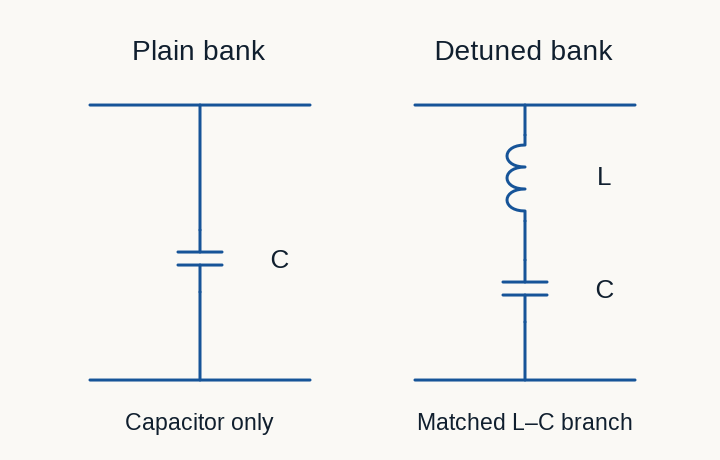
- A reactor changes branch impedance and capacitor voltage duty.
- Choose the reactor and capacitor as a compatible combination.
- Assess resonance with the network; detuning alone does not guarantee harmonic compliance.
Separate two different resonance questions
A plain bank changes the impedance seen by harmonic currents. Its interaction with supply inductance can place a parallel resonance near an existing harmonic. That risk depends on source strength and connected capacitance, so a bank that operates acceptably in one supply arrangement cannot simply be assumed suitable for another.
In a detuned branch, the reactor and capacitor have their own series resonant frequency. This is a different quantity from the network parallel resonance. The selected branch must be assessed together with the supply and loads. A label such as detuned does not eliminate the need to check alternative transformer and generator configurations.
Interpret the reactor percentage correctly
The detuning ratio expresses reactor reactance relative to capacitor reactance at the fundamental frequency. In an ideal series branch, its resonant frequency follows fr = f1 / sqrt(p), with p expressed as a fraction. This is a calculation relationship, not a list of manufacturer products or a recommendation for a site.
The reactor raises the fundamental voltage across the capacitor. It is misleading to say that adding a reactor always reduces kvar for the same capacitor. At unchanged supply voltage and capacitance, the series combination reduces net capacitive reactance and increases branch current below resonance. Ratings, reference voltage and assembled kvar must therefore be compared consistently.
Specify the combination and its operating conditions
Capacitors and reactors must be matched for the required voltage, thermal duty and reactive output. Do not retain an existing capacitor purely because its nominal kvar resembles the new requirement. Obtain the complete combination data, including its permitted harmonic duty, rather than treating the reactor as an interchangeable accessory.
Ask the design review to consider existing stages, switching states and future loads. A plant that changes its source configuration or extends nonlinear loads may change the harmonic conditions. The procurement record should identify the evidence used and the conditions that would trigger reassessment. Detuning protects a correction arrangement; a separately designed filter may be needed to reduce distortion at the required assessment point.
| Decision | Plain bank | Detuned bank |
|---|---|---|
| Branch construction | Capacitors without series reactors | Matched reactor-capacitor branches |
| Selection evidence | Correction demand and resonance assessment | Correction demand, spectrum and combination data |
| Voltage assessment | Capacitor operating conditions | Includes reactor-induced capacitor voltage |
| Distortion objective | Not a harmonic filter | Not automatically a complete filtering solution |
Frequently asked questions
Does every installation with drives need a detuned bank?
Not solely because a drive is present. The decision depends on its contribution to the operating spectrum, the network impedance and the capacitance being connected. Measurement and a resonance assessment are needed. The same drive population can have different consequences under a different transformer, generator or stage-switching arrangement.
Can I add reactors to existing capacitors?
Only after the complete combination has been checked. A reactor changes current, capacitor voltage and thermal duty. Existing nameplate kvar is not enough to demonstrate suitability. Ask for compatible manufacturer data and verify the operating conditions before retaining components; otherwise the modification may create duties that the original capacitors were not selected to withstand.
Will detuning guarantee harmonic compliance?
No. Detuning addresses the behaviour of the capacitor branch within the network. Compliance requires a defined assessment point, applicable limits, agreed operating conditions and measurements or analysis of the whole system. If reducing load-produced harmonic currents is the objective, active, passive or hybrid mitigation may require a separate engineering study.
Plan the next step
Explore the relevant product range · Use the planning calculator · Contact NPE